

Understanding how baby carrier wraps work can feel like one of those things that looks impossibly complicated until someone simply explains it. A wrap is a single, long piece of fabric you tie around your body to hold your baby close, hands-free, in a position that supports healthy development. Many new parents hesitate because the fabric looks overwhelming at first. But once you understand the mechanics, the types, and the safety principles, wraps become one of the most intuitive and rewarding tools in early caregiving.
Table of Contents
- Key takeaways
- How baby carrier wraps work: the core mechanics
- Types of baby carrier wraps and how to choose
- Safety principles for using baby carrier wraps
- How to use baby wraps: a practical tying guide
- The wider benefits of baby wraps
- My honest take on learning baby wraps
- Carry more than your baby
- FAQ
Key takeaways
| Point | Details |
|---|---|
| One fabric, many carries | Baby wraps are a single piece of cloth tied to create a custom, ergonomic seat for your baby. |
| Two main wrap types | Stretchy wraps suit newborns up to around 20 lbs; woven wraps support babies and toddlers up to 45 lbs. |
| Safety follows T.I.C.K.S. | Tight, In view, Close enough to kiss, Keep chin off chest, and Supported back are the five principles to memorize. |
| Tension is everything | Firm, even fabric tension before placing baby is what makes a wrap safe and comfortable. |
| Benefits go beyond carrying | Wraps reduce infant crying, support nervous system regulation, and make breastfeeding more discreet. |
How baby carrier wraps work: the core mechanics
At their simplest, baby wraps use a single long piece of fabric tied around the caregiver’s body to create a snug, ergonomic seat. There are no buckles, no frames, and no rigid structure. The fabric itself does all the work, distributing your baby’s weight across your shoulders, back, and hips so no single point bears the full load.
The key to understanding how wraps function is fabric tension. When you pull each layer of fabric taut before placing your baby, you create a firm, supportive pocket that holds the baby’s body in alignment. Think of it like the tension in a hammock. Slack fabric sags and shifts; taut fabric holds shape and distributes weight evenly.
The M-position and why it matters
The most critical concept in babywearing is the “M-position,” sometimes called the frog-leg or spread-squat position. When positioned correctly, your baby’s knees sit higher than their bottom, and their legs form a natural M-shape when viewed from the front. This position mirrors the natural posture of a newborn and actively supports healthy hip socket development.
Here is what proper wrap mechanics create for your baby:
- Ergonomic seat: Fabric spreads from knee to knee, cradling the pelvis rather than letting the legs dangle.
- Spinal support: The wrap cups the baby’s natural curved spine without forcing it straight.
- Head support: Layers of fabric hold the head close to the caregiver’s chest, reducing strain on the neck.
- Airway alignment: The chin stays off the chest, keeping the airway open at all times.
Most wraps allow three primary carry positions. Stretchy wraps are best suited to front carries only. Woven wraps, because of their non-stretch structure, support front, back, and hip carries as your baby grows.
Pro Tip: Before placing your baby in a wrap, do a “tension check” by pressing the fabric firmly with your palm. If it moves more than an inch, tighten each layer before proceeding.
Types of baby carrier wraps and how to choose
Not all wraps behave the same way, and choosing the right type makes a real difference in your daily experience. The two main categories are stretchy wraps and woven wraps, and each has a distinct feel, weight limit, and learning curve.
Stretchy wraps
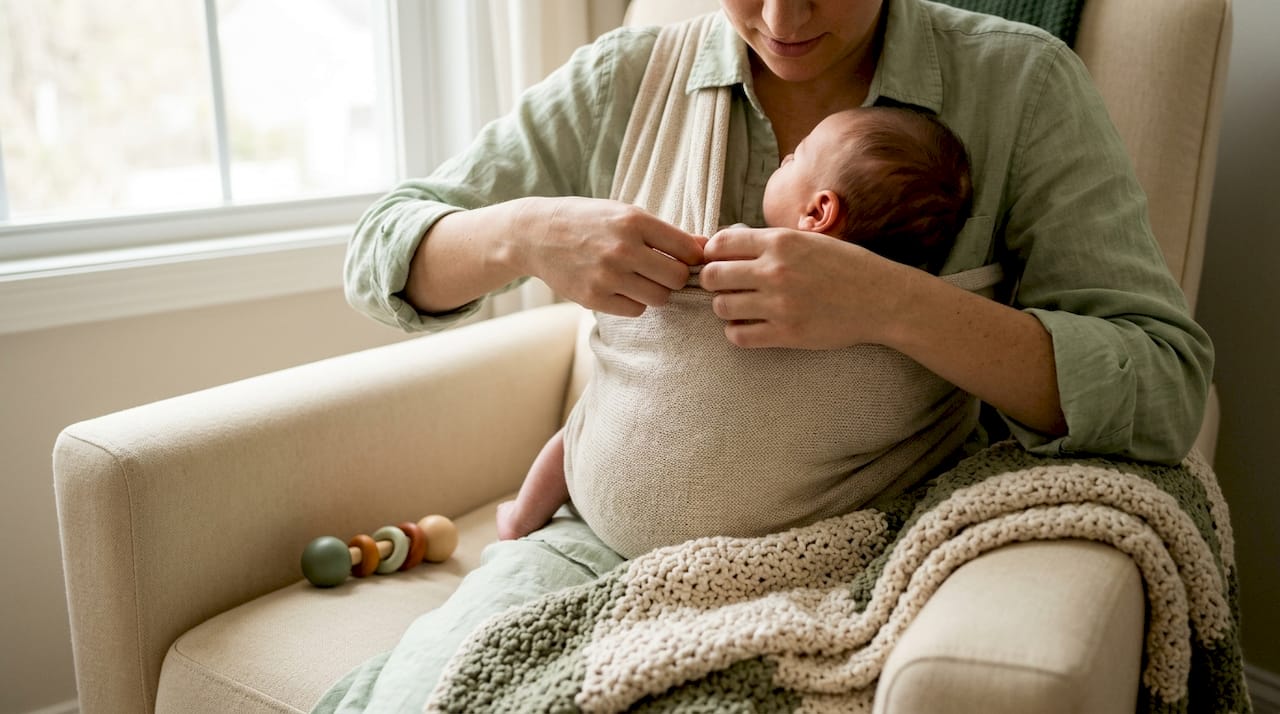
Stretchy wraps are made from knit fabric, most often a cotton-spandex or modal blend. They feel soft and forgiving, which makes them especially popular for newborns. The fabric gives slightly as you tie, allowing you to pre-tie the wrap before your baby is even in it. Brands like Moby and Solly Baby are well-known examples in this category. Stretchy wraps are recommended up to around 12 to 20 lbs, after which the fabric begins to sag under the baby’s weight and loses its supportive structure.
Woven wraps
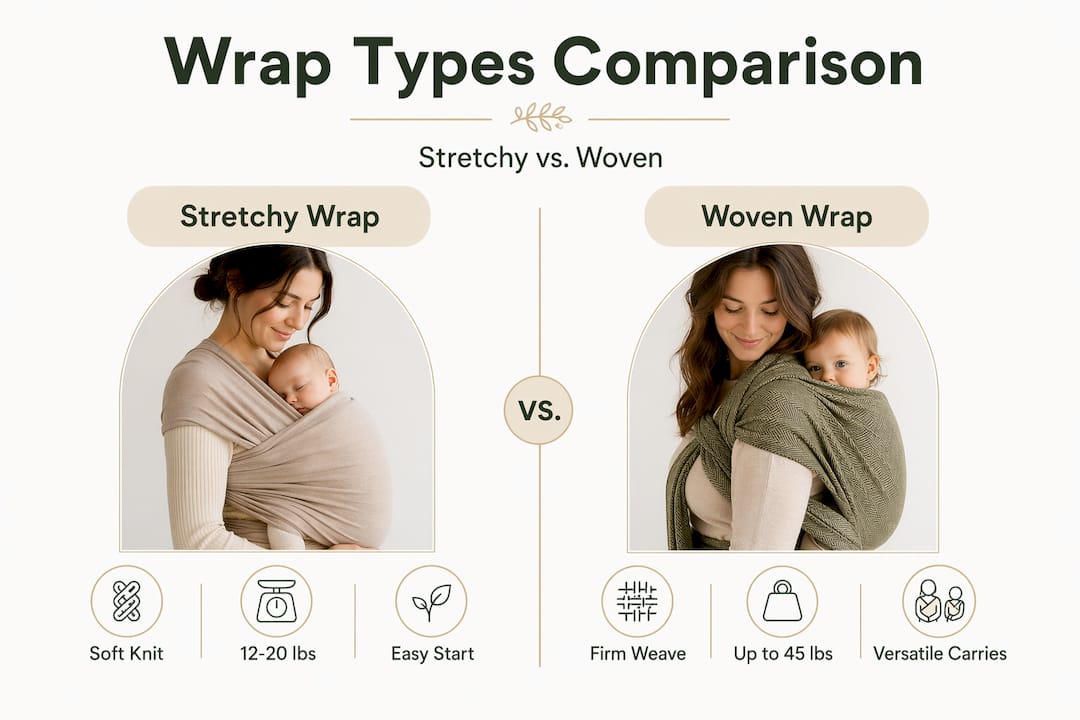
Woven wraps are made from non-stretch fabric, typically woven cotton, linen, hemp, or blends of these. Because the fabric does not give, it holds heavier babies with more precision and supports carries up to approximately 45 lbs, including back and hip positions. The trade-off is that woven wraps have a steeper learning curve. They require more passes of fabric and more deliberate tensioning.
Weave type influences grip, stretch, and shoulder comfort more than fabric density alone. Longer float weaves feel softer and more pliable but may snag more easily. Shorter, tighter weaves offer more grip and durability.
| Feature | Stretchy wrap | Woven wrap |
|---|---|---|
| Weight limit | 12 to 20 lbs | Up to 45 lbs |
| Fabric type | Knit, stretchy blend | Non-stretch woven fabric |
| Best age range | Newborn to 4 months | Newborn through toddler |
| Carry positions | Front carry only | Front, back, hip |
| Learning curve | Gentle | Moderate to steep |
| Pre-tying possible | Yes | No |
Experienced babywearers often notice the structural limits of stretchy wraps around 15 to 20 lbs and transition to woven wraps for continued support as their baby matures.
Safety principles for using baby carrier wraps
Safety in babywearing is not about fear. It is about understanding a few clear principles and applying them consistently. The most widely used framework is the T.I.C.K.S. rule, and it defines the five principles of safe positioning:
- Tight: The wrap should hold your baby firmly against your body with no slack.
- In view: Your baby’s face should always be visible to you without moving fabric.
- Close enough to kiss: Your baby’s head should be close enough that you can kiss their forehead by simply tilting your chin down.
- Keep chin off chest: A chin dropped to the chest can restrict the airway. Two fingers should fit between chin and chest.
- Supported back: The baby’s back should be supported in its natural curve, not slumped forward.
Around 40% of new parents tie wraps too loosely, which is the most common safety mistake. A loose wrap allows the baby to slump or slide, putting pressure on the airway and straining the caregiver’s back.
Sleep and duration guidelines
Daytime supervised naps in a well-fitted wrap are generally safe, but overnight sleep in a carrier is not recommended. The American Academy of Pediatrics continues to advise that firm, flat sleep surfaces are safest for overnight rest. Keep carries to manageable durations, take breaks, and always check your baby’s positioning every 15 to 20 minutes.
Pro Tip: Practice tying your wrap with a stuffed animal or doll before your baby arrives. This builds muscle memory for tension and positioning without any pressure.
How to use baby wraps: a practical tying guide
Learning how to use baby wraps begins with one foundational habit: find the center of your wrap before you do anything else. Most wraps have a woven or sewn center marker. That center mark sits at your sternum, and everything else unfolds from there.
Here is a simplified approach to the most beginner-friendly technique, the pocket wrap cross carry (PWCC):
- Find center and place it at your sternum. Hold both tails out to the sides at hip level.
- Cross the tails behind your back. Bring each tail over the opposite shoulder so they cross between your shoulder blades.
- Bring tails to the front and cross them over your chest. Each tail should pass over the center panel, creating an X across your chest.
- Thread tails under the waist band. Pull each tail down and under the horizontal band at your waist, then tie them securely at your back or front.
- Spread the fabric into a seat. Before placing baby, open the center panel into a wide pocket, spreading fabric from knee to knee.
- Place baby in the seat and tighten each layer. Work from the waist band up, pulling each pass of fabric snug before moving to the next.
Achieving proper wrap tension requires firm base layers before adding any baby weight. Tightening after the baby is in place is much harder and less effective.
A common frustration for new wearers is fabric dragging on the floor during tying. Controlling the fabric by gathering it in your hands first before unfolding it onto your body keeps it clean and makes the process feel more manageable. Moby wraps require tighter initial tension due to their stretchiness, while Solly wraps benefit from gentler handling across multiple fabric passes.
Pro Tip: Watch yourself in a mirror or record yourself tying. Seeing your own technique from the outside reveals tension gaps that are hard to feel from the inside.
The wider benefits of baby wraps
The benefits of baby wraps extend well beyond convenience. When used consistently and correctly, babywearing reduces infant crying by 43% and supports more settled sleep patterns. The physical closeness of a wrap replicates the sensory environment of the womb, which is particularly calming for newborns adjusting to the world.
Skin-to-skin contact within a wrap also regulates your baby’s temperature, heart rate, and breathing. Babywearing fosters infant nervous system regulation and strengthens the attachment bond between caregiver and child. For babies with reflux, the upright positioning a wrap provides can meaningfully reduce discomfort after feeding.
“Wraps are more than convenience tools. They serve vital physiological and emotional roles in early parenting.” Babywearing is not a fad
Breastfeeding while babywearing is also possible once you and your baby are both comfortable with the wrap. Many caregivers find the privacy and hands-free positioning makes nursing in public feel far less stressful. And for busy parents managing older children, household tasks, or simply needing to move through the world, a well-tied wrap gives back a freedom that a stroller simply cannot replicate.
My honest take on learning baby wraps
I’ve worked with many families navigating the early weeks of parenthood, and the hesitation around baby wraps follows a predictable pattern. The fabric looks like too much. The tying looks like origami. And the fear of doing something wrong feels paralyzing.
What I’ve found, again and again, is that the learning curve is real but short. Most parents feel genuinely confident after three to five practice sessions. The bigger obstacle is not the technique. It is the misconception that wraps are fragile systems where one mistake means failure. They are not. They are layered, forgiving tools that reward patience and repetition.
I’ve also noticed that parents who lean into wraps early, in those first tender weeks, often describe something that goes beyond utility. There is a quality of presence that wrapping creates. Your baby breathes against your chest. You feel their weight settle. The world slows, just slightly. Wraps remain the preferred option in the initial postpartum weeks precisely because that closeness cannot be replicated by any structured carrier or stroller.
My honest advice: buy one stretchy wrap, practice with a doll, and give yourself permission to be a beginner. The wrap will meet you where you are.
— RGDEnterprise
Carry more than your baby
At Rgdenterprise, we believe that caring for a new baby should feel supported at every level, not just in how you carry your little one, but in how you carry yourself through each day. Whether you are heading out for a morning walk with your baby wrapped close or managing a full day of errands, having the right accessories makes the difference.

A personalized leather tote pairs beautifully with a babywearing lifestyle, keeping your essentials organized while your hands stay free for what matters most. For parents who want to keep their wraps and fabric accessories in top condition, a handheld fabric steamer is a practical addition to any caregiving routine. Explore the full range at Rgdenterprise and find products that move with you.
FAQ
What is a baby carrier wrap made of?
Baby carrier wraps are made from either stretchy knit fabric, such as cotton-spandex blends, or non-stretch woven fabrics like cotton, linen, or hemp. The material determines weight limits, carry positions, and overall feel.
How long does it take to learn how to tie a baby wrap?
Most new parents feel confident tying a wrap after three to five practice sessions. Starting with a stuffed animal before using the wrap with your baby helps build muscle memory without pressure.
Are baby carrier wraps safe for newborns?
Yes, when used correctly and following the T.I.C.K.S. safety rule, baby carrier wraps are safe for newborns. The key factors are firm fabric tension, the M-position for hips, and keeping the chin off the chest to protect the airway.
What is the difference between a stretchy and a woven wrap?
Stretchy wraps are made from knit fabric and work best for newborns up to around 20 lbs, while woven wraps use non-stretch fabric and support babies up to 45 lbs across more carry positions including back and hip carries.
Can you breastfeed while using a baby wrap?
Yes, many caregivers breastfeed while babywearing once they are comfortable with both the wrap and nursing. The hands-free positioning and natural closeness of a wrap make discreet nursing practical in most settings.
Recommended
- Portable Indoor Outdoor 2-Person Double Hammock Set with Stand and Car – RGD Essentials Market
- Arm Band Phone Pouch – Secure SYB Fitness Holder – RGD Essentials Market
- Crop Tank Top for Women – Starry Sweet Baby Girl Top – RGD Essentials Market
- Compact Handheld Fab ric Steamer- Travel Ready – RGD Essentials Market
0 comments